https://www.acmicpc.net/problem/7576
문제 요약
- 2차원 격자에서 토마토가 익어간다.
- 1: 익은 토마토, 0: 안 익은 토마토, -1: 빈 칸
- 하루가 지나면 익은 토마토의 상하좌우 토마토가 익는다.
- 모든 토마토가 익기까지 걸리는 최소 일수를 구하라.
- 끝까지 익지 못하는 토마토가 있다면 -1 출력
문제를 보고 처음 든 생각들
문제를 딱 읽고 나서 정리한 생각은 이랬다.
- 0이 고립되어 있으면 → 이건 무조건 fail
- 입력 받을 때 1이 있는 위치는 전부 시작점이 될 수 있음
- 하루 단위로 퍼져나가니까 DFS는 아니고 BFS
- BFS를 다 돌고 나서 가장 깊은 depth가 정답일 듯?
❌ 처음에 시도한 방법 (실패)
내가 처음에 생각한 방식은 이거였다.
- 시작점(1)이 여러 개니까
- 각 시작점마다 BFS를 각각 실행
- depth를 기록한 격자를 하나 두고
- 여러 BFS 결과 중에서 가장 작은 depth만 남기자
말로 쓰면 그럴듯해 보이는데, 곧 문제가 보였다.
왜 안 되는가?
- BFS를 시작점 개수만큼 실행해야 함
- BFS 결과를 저장할 격자도 여러 개 필요
- 그걸 또 전부 비교해야 함
즉,
👉 BFS를 많이 돌리는 구조 자체가 이미 비효율적
실제로 이 방식으로 코드를 짜봤지만, 구조도 복잡해지고 성능도 별로였다.
(아래 코드는 이 방식으로 시도했다가 실패한 코드)
#include <bits/stdc++.h>

using namespace std;

int dx[]={-1,0,1,0};
int dy[]={0,1,0,-1};

vector<vector<int>> result_box;
vector<vector<int>> box;
void bfs(int i, int j);
int count_days();
int m, n;


int main(){
    ios::sync_with_stdio(false);
    cin.tie(NULL);
    cout.tie(NULL);
    cin>>m>>n;
    box = vector<vector<int>> (n, vector<int>(m));//초기 입력값
    result_box= vector<vector<int>>(n, vector<int>(m)); //bfs depth 저장 box
    vector<pair<int,int>> starts;

    for(int i=0;i<n;i++){
        for(int j=0 ; j<m; j++){
            cin>>box[i][j];
            if(box[i][j]==1) starts.push_back({i,j}); // 초기 start들 저장해두기
        }
    }

    for(auto& tomato : starts){
        //각각의 start들을 차례대로 bfs를 한다.
        cout<<tomato.first<<'\n';
        bfs(tomato.first, tomato.second);

    }

    cout<<count_days(); //최종 날짜

    return 0;
}

void bfs(int i, int j){
    queue<pair<int,int>> q;
    q.push({i,j});
    result_box[i][j]=1; //start를 1일로 함

    while(!q.empty()){
        auto[a,b] = q.front();
        q.pop();
        int old_depth=result_box[a][b];
        for(int k=0;k<4;k++){
            int ny= a+dy[k];
            int nx = b + dx[k];
            if(ny<0||ny>=n || nx<0 || nx>= m || box[ny][nx]==-1) continue; //경계검사
            int new_depth=result_box[ny][nx];
            if(new_depth>=1){
                result_box[ny][nx]= min(new_depth,old_depth+1);
            }
            if(new_depth==0) result_box[ny][nx] = old_depth+1;
            else result_box[ny][nx]= min(new_depth,old_depth+1);
        }
    }
}

int count_days(){
    int max=1;
    for(int i=0;i<n;i++){
        for(int j=0;j<m;j++){
            if(result_box[i][j]==0) return -1; //안 익은 토마토 발견
            if(result_box[i][j]>max){
                max=result_box[i][j]; // bfs 최종 맵에서 가장 큰 값 찾기
            }
        }
    }

    return max-1; //start를 1로 쳤으니 -1 해서 return
}
사고 전환 포인트
이 문제를 처음 이해하려고 했을 때는, 다음과 같 그림을 그리면서 생각했다.
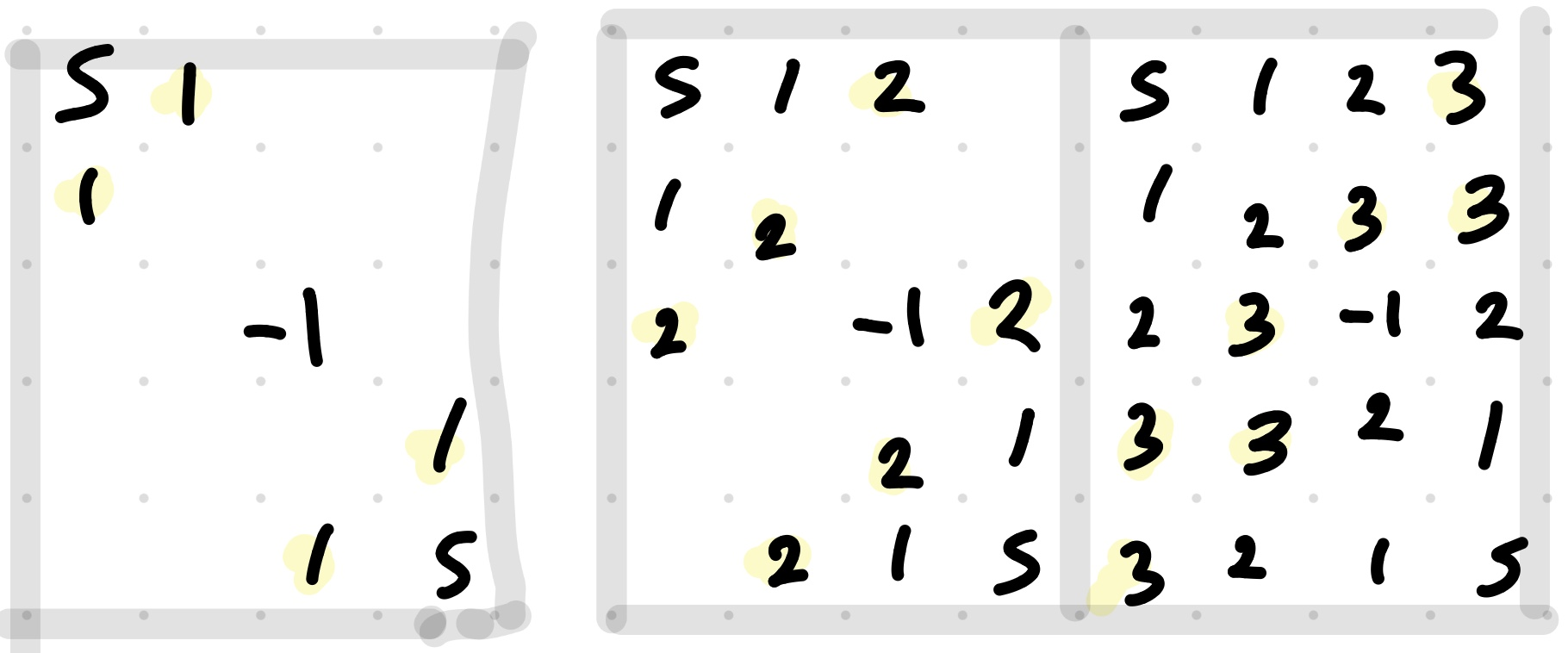
- Day 0: 익어 있는 토마토들
- Day 1: 거기서 한 칸 떨어진 토마토들
- Day 2: 또 그 다음 칸들 ...
문제 해결 실패 후 다시 그림을 그리다 보니 BFS의 의미에 대해서 생각하게 되었다. 그림에서 여러 시작점들에서 근처를 단계별로 넓혀나가는 모양 자체가 BFS 같았다.
BFS는 말 그대로 너비 우선 탐색이다. 그 의미는 다음과 같다.
- 큐에 들어간 순서대로 처리
- 같은 depth에 있는 노드들이 먼저 확장됨
그렇다면:
- 시작점이 여러 개라면?
- 처음부터 큐에 시작점이 다 있다면 단계적으로 확장하면 되지 않을까?
🔑 다중 시작점 BFS
이 아이디어를 떠오른 후 수도 코드를 작성하며 생각을 정리해보았다.
- 입력을 받으면서
- 1인 좌표를 전부 큐에 넣기
- 이 좌표들의 depth를 1로 설정
- 큐가 빌 때까지 BFS
- 상하좌우 확인
- 아직 방문 안 한 0만 방문
- depth = 이전 depth + 1
- BFS 종료 후 검사
- 0이 남아 있으면 -1
- 아니면 depth의 최댓값 - 1
겹치는 경우는?
서로 다른 시작점에서 퍼진 BFS가 중간에 만나는 경우가 생길 수 있다.
근데 이건 신경 쓸 필요가 없다.
- BFS 특성상 더 가까운 쪽이 먼저 방문 처리됨
- 나중에 도착한 경로는 이미 visited라서 자연스럽게 무시됨
추가 비교 로직이 필요 없다.
최종 코드 (C++)
#include <bits/stdc++.h>

using namespace std;

int dx[]={-1,0,1,0};
int dy[]={0,1,0,-1};

vector<vector<int>> result_box;
vector<vector<int>> box;
void bfs(queue<pair<int,int>> q);
int count_days();
int m, n;


int main(){
    ios::sync_with_stdio(false);
    cin.tie(NULL);
    cout.tie(NULL);
    cin>>m>>n;
    box = vector<vector<int>> (n, vector<int>(m));//초기 입력값
    result_box= vector<vector<int>>(n, vector<int>(m)); //bfs depth 저장 box
    queue<pair<int,int>> starts;

    for(int i=0;i<n;i++){
        for(int j=0 ; j<m; j++){
            cin>>box[i][j];
            if(box[i][j]==1) starts.push({i,j}); // 초기 start들 저장해두기
        }
    }

    bfs(starts);

    cout<<count_days(); //최종 날짜

    return 0;
}

void bfs(queue<pair<int,int>> starts){
    queue<pair<int,int>> q;
    while(!starts.empty()){
        auto[a,b]=starts.front();
        starts.pop();
        q.push({a,b});
        result_box[a][b]=1; //start를 1일로 함
    }

    while(!q.empty()){
        auto[a,b] = q.front();
        q.pop();
        int old_depth=result_box[a][b];
        for(int k=0;k<4;k++){
            int ny= a+dy[k];
            int nx = b + dx[k];
            if(ny<0||ny>=n || nx<0 || nx>= m || box[ny][nx]==-1) continue; //경계검사
            if(result_box[ny][nx]>=1) continue; //이미 visited은 pass
            q.push({ny,nx});
            result_box[ny][nx]=old_depth+1; //depth 추가
        }
    }
}

int count_days(){
    int max=1;
    for(int i=0;i<n;i++){
        for(int j=0;j<m;j++){
            if(result_box[i][j]==0 && box[i][j]==0) return -1; //고립된 안 익은 토마토 발견
            if(result_box[i][j]>max){
                max=result_box[i][j]; // bfs 최종 맵에서 가장 큰 값 찾기
            }
        }
    }

    return max-1; //start를 1로 쳤으니 -1 해서 return
}
시간 복잡도
입력 처리, BFS 탐색, 결과 검사 모두 O(n *m) 시간복잡도이다.
'Algorithms > Problem Solving' 카테고리의 다른 글
| [백준] 치킨배달 15686 (Gold 5) - C++ (0) | 2026.02.15 |
|---|---|
| [백준] 이분 그래프 1707 (Gold 4) - C++ (0) | 2026.02.09 |
| [백준] 단지번호붙이기 2667 (silver 1) - c++ (0) | 2026.02.01 |
| [백준] DFS와 BFS 1260 (Silver 2) - C++ (0) | 2026.02.01 |
| [프로그래머스] 영어 끝말잇기 (12981) - C++ (0) | 2026.01.25 |